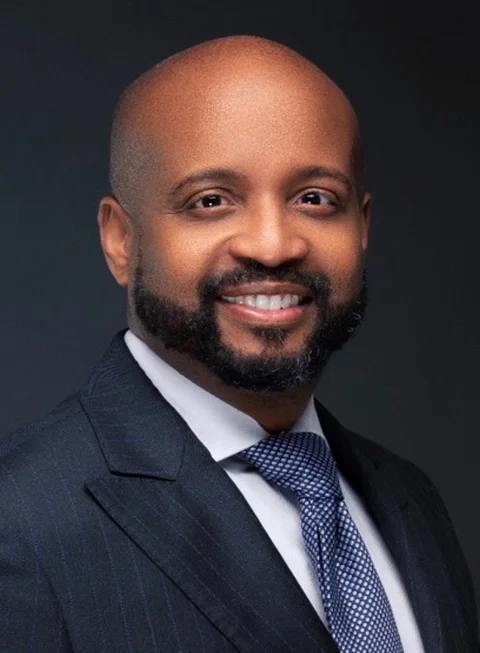
Dr. Kester Crosse joined Les Allen Jr. on The ReBuild Podcast for an episode titled "Business of Medicine: After the White Coat Goes On". The conversation covers the gap between clinical training and the professional skills a physician actually needs: negotiation, communication, reputation, and the relationships that decide which opportunities appear.
Medical training is extraordinarily good at one thing and almost silent on another.
It will teach you to read a scope, hold a differential in your head at two in the morning, and tell a family something nobody wants to hear. It will not teach you how a contract is negotiated, how a partnership decision is actually made, or why the person in the room with the least clinical skill is sometimes the one shaping your career.
That gap is what Les Allen and I spent the episode on.
Why this show
I want to say something about the host, because it is the reason I said yes.
The ReBuild is not a motivational podcast, and Les Allen says so himself in the show's own description. His framing is that he is there "to loan you my scar tissue so you don't have to earn all of your own."
I have been on the other kind of show. The kind where the questions arrive pre-agreed and everyone performs certainty. This was not that. Les has spent three decades building businesses, and he asks the question underneath the question, which is a harder skill than it looks and a rarer one than it should be.
Loaned scar tissue is the cheapest education there is. Most people refuse it and pay full price.
What we actually covered
The white coat is a credential, and credentials are strange things. They open the first door and then stop working. Inside the building, what moves is the same set of behaviours that moves in any other profession, and almost none of it was on the syllabus.
- Why clinical excellence and career progression are only loosely correlated, and what closes the distance
- What physicians are never taught about negotiating, and what it costs across a career
- Reputation as an asset that compounds or decays, but never sits still
- Why the relationships you build in your first five years decide which rooms you are in at fifteen
That last point is the one I keep returning to. It is the argument of the prologue of Open Doors, and it is not a medical observation. It is the same in law, in engineering, in every field where people assume the work speaks for itself.
The part that applies to everyone
If you are not a physician, none of this is really about medicine.
Substitute your own credential. The degree, the certification, the licence, the years of training that were supposed to be sufficient. Every profession hands people a thing that opens the first door and then quietly expects them to have learned the rest somewhere else. Some people were taught it at the dinner table. Most were not, which is the exposure gap, and it is the reason I wrote the book.
The four things that actually move are measurable, which is the entire point of the TEEE Score. Talent got you the credential. Effort, Energy and Execution decide what happens after.
Where to find it
The episode is on The ReBuild with Les Allen. If you are early in a career in medicine, or advising someone who is, it is the conversation I wish somebody had put in front of me at thirty.
My thanks to Les for the invitation, and for asking better questions than I was ready for.
Score yourself on the four that matter
Talent opened the first door. The free TEEE Score tells you which of the other three is costing you the ones after it.
Frequently asked
What is The ReBuild Podcast?
A show hosted by Les Allen on practical mental models, decision frameworks and business lessons for people building or rebuilding after a setback. It publishes on YouTube at @ReBuildWithLesAllen.
What did Dr. Crosse discuss on the episode?
The professional skills medical training does not cover: negotiation, communication, reputation, and the relationships that determine which opportunities a physician is offered after qualification.
Does this only apply to physicians?
No. Every profession issues a credential that opens the first door and then assumes the rest was learned elsewhere. The episode is about what that assumption costs, whatever the field.