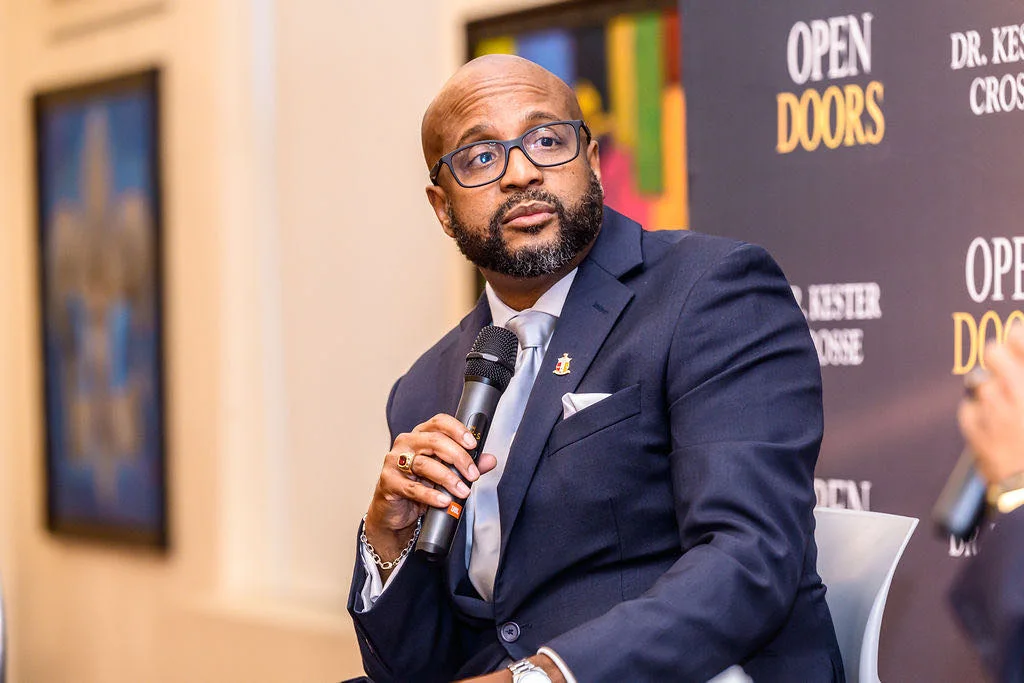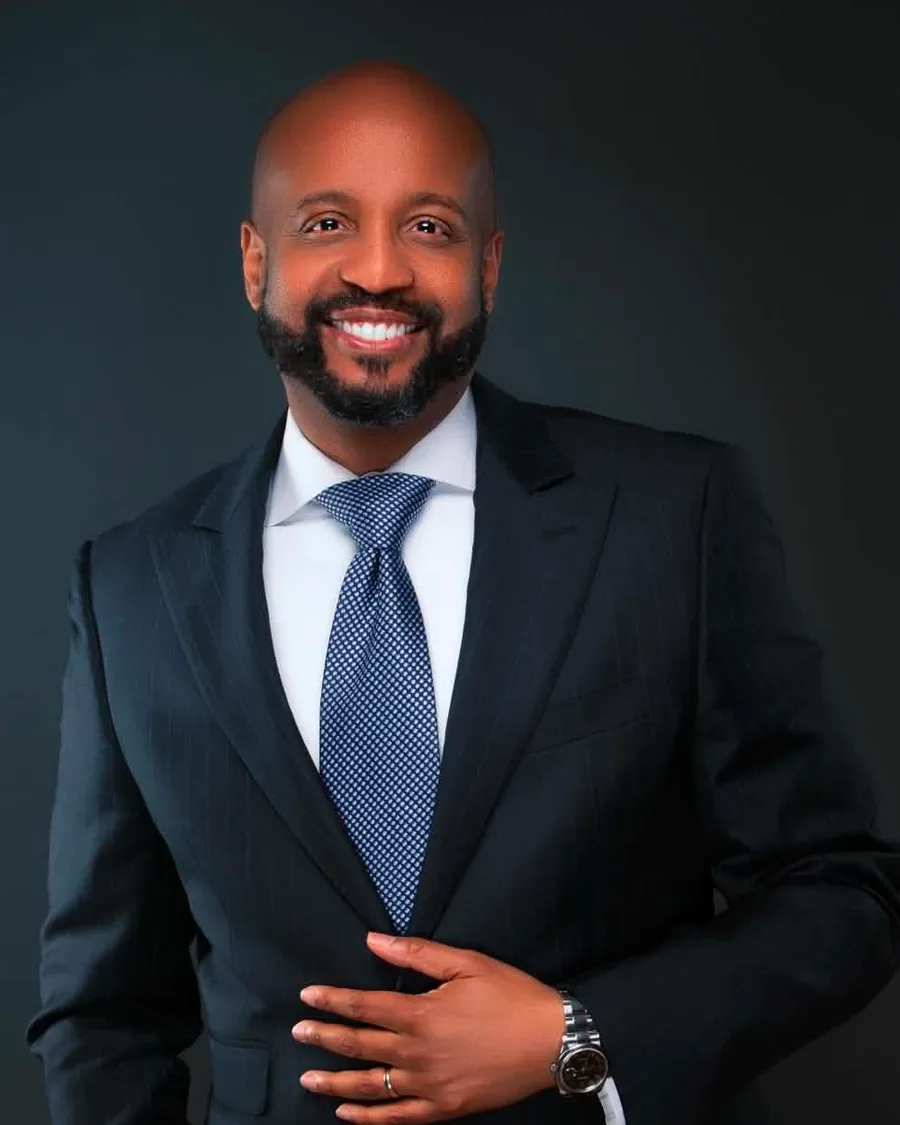
Dr. Kester Crosse is a board-certified gastroenterologist who has spent decades evaluating, hiring, coaching, and mentoring students, athletes, and professionals across academic, corporate, and clinical settings. Open Doors is what he had been teaching one-on-one for years, written down.
He speaks to the rooms he wrote it for: students about to graduate into a market nobody prepared them for, and the people responsible for getting them ready.
Each one maps to a named chapter in Open Doors, so an audience can carry on working after he leaves. Pick one to see what it covers, what the room does, and what people walk out holding.
The keynote. Why the most talented person in the room is so often not the one who gets the opportunity, and what the person who did get it was doing differently. Opens with the argument, closes with the four things an audience can score themselves on before they leave.
Closes with a live self-score across the four TEEE dimensions. Everybody leaves holding a number out of forty rather than a feeling.
Daniel Goleman — Emotional Intelligence: Why It Can Matter More Than IQ (Bantam, 1995).
Pirsoul, Parmentier & Nils (2023) — Emotional intelligence and career-related outcomes: a meta-analysis. Human Resource Management Review 33(3).
Ernst & Young & espnW (2022) — The case for athlete-inspired leadership.
Can be shortened to a keynote or opened out into a workshop.
Check a date for this talkThe interactive one. Every person in the room scores themselves live across Talent, Effort, Energy, and Execution, out of forty. They leave holding a number and knowing which single dimension to work on first — which is the part that actually changes behaviour.
Everyone scores themselves 1–10 on each dimension — no 7 allowed — and totals it out of forty, in the room, on paper.
Then the harder half: pairs score each other. The distance between the two numbers — especially on Energy, which nobody experiences from the outside — is the part people remember.
Suárez-Albanchez et al. (2023) — Emotional intelligence, leadership and work teams: a hybrid literature review. Heliyon 9(10).
Works best with a defined cohort that will still be together afterwards — the shared vocabulary is most of the value.
Check a date for this talkThe one people are most afraid of. The 5-Second Rule, the Compliment + Introduction opener, the FROM Method, and YES → ADD → ASK — taught, then practised in the room, so nobody leaves having only heard about it.
People actually get up and do it. Rounds of live practice with strangers in the room, then a written follow-up message drafted on the spot.
The room is deliberately reorganised so nobody practises on the person they came with.
Zippia Career Research (2023) — Employee referral statistics: how referrals impact hiring.
Keith Ferrazzi — Never Eat Alone (Crown Business, 2005).
Forrier, De Cuyper & Akkermans (2024) — The role of social capital in employability models. Sustainability 17(5).
NACE (2024) — Job Outlook 2024.
The most requested of the six, and the one that needs room to move — a flat floor beats a lecture hall.
Check a date for this talkPast, Present, Purpose — sixty seconds, three beats. Built for interviews, career fairs, and any room where someone asks "so tell me about yourself" and watches you fumble it. Everyone drafts and says theirs out loud.
Ten uninterrupted minutes to write three sentences: "My childhood taught me ______." "Today, I am a person who ______." "My purpose is to ______."
Then everyone says theirs out loud — to a partner first, then a handful to the whole room. Saying it is the part that makes it stop sounding written.
Pairs naturally with career fairs and interview season — best delivered two to three weeks before, so there is time to practise.
Check a date for this talkMarket value is what people say about you when you are not in the room, and it is built out of daily choices rather than titles. Coachability, follow-through, and the habits that quietly compound over a decade.
A seven-day awareness assignment: notice how you enter rooms, how you listen, how often the phone wins. Change nothing at first — you cannot improve what you have not noticed.
The one that lands best with people already in work rather than students — ERGs and early-career cohorts especially.
Check a date for this talkFor faculty, staff, and programme leaders rather than students. Why first-generation and underrepresented students arrive without the unwritten rules, what that costs them, and what an institution can actually do about it.
A working discussion rather than an exercise — where each institution's own gap actually sits, and which of its existing touchpoints could carry this without new headcount.
Mobley & Johnson (2024) — The HBCU advantage: reimagining social capital. Frontiers in Education 9.
Harker & Shanks (2024) — The impact of mentoring in higher education.
Frequently booked alongside a student-facing talk on the same visit — staff in the morning, students in the afternoon.
Check a date for this talkWhat makes this book stand out is that it is based on experience rather than theory. This is not a book about changing who you are. It is a book about sharpening how you show up.
Rick DeadwylerU.S. Region Corporate Affairs Executive · from the foreword to Open Doors
Tell us about the event and you'll get availability and a fee range back by email. No obligation, and no call required to get a number.
How do I book Dr. Kester Crosse to speak?
Submit the enquiry form on this page with your event date, audience size, and format. You will receive a reply with availability and fee range, typically within two business days.
What topics does Dr. Crosse speak on?
Career readiness, emotional intelligence, professional communication, networking and cold conversations, personal storytelling, and market value — all drawn from his book Open Doors. He also speaks to faculty and staff on the exposure gap facing first-generation students.
What audiences is this suited to?
College and university students, first-year and career-readiness programmes, athletic departments, fraternity and sorority chapters, employee resource groups, and early-career professional cohorts.
Does he deliver keynotes or workshops?
Both. Keynotes run 45 to 60 minutes. Workshops run 60 to 90 minutes and are interactive — audiences score themselves and practise in the room rather than only listening.
Can books be included with a speaking engagement?
Yes. Copies of Open Doors at volume pricing are frequently bundled with an engagement, and signed copies can be arranged for attendees.
Audiences who have read Open Doors before the event ask better questions. Volume pricing starts at 25 copies and can be quoted alongside the engagement.